3 Psychological Traps That Can Kill Your Real Estate Returns

At a Glance
This article explores the three most common psychological traps that derail real estate investors. While many focus on pricing, yields, and IRRs, mindset often has a greater impact on long-term outcomes.
By understanding crowd behavior, overconfidence, and emotional attachment, investors can protect capital, make objective decisions, and avoid subtle pitfalls that quietly erode wealth over time.
Core insight: Your mindset can make or break your returns.
Real estate investing is not just about property prices, rental yields, or projected returns. For serious investors, the difference between a high-quality investment and a stagnant one often lies in psychology. Even experienced investors fall into predictable mental traps by buying into hype, overestimating intuition, or allowing emotion to override analysis. These biases rarely cause immediate losses but can materially reduce returns over years, even when the initial numbers appear attractive.
Trap 1: Following the Crowd
Hot markets are persuasive. Headlines amplify momentum, prices rise rapidly, and buying activity becomes self-reinforcing.
The risk: When demand is driven primarily by sentiment, prices may already reflect peak optimism. Buying because others are buying often leads to muted capital appreciation or long holding periods with limited upside. Example: Investors who purchased residential plots in Gurgaon during the 2019 boom often experienced price stagnation for several years despite strong initial narratives. Smart move: Focus on fundamentals rather than momentum. Evaluate rental yields, occupancy levels, absorption rates, and real end-user demand. Data should lead decisions, not headlines.
Trap 2: Overconfidence
Many investors believe they can consistently identify the next high-growth micro-market or time entries with precision.
The risk: Acting on intuition instead of analysis increases exposure to mispriced assets and underperforming locations. Example: Acquiring a project because it appears promising, without evaluating DSCR, vacancy risk, or rental sustainability, often results in lower realised returns. Smart move: Discipline beats instinct. Metrics such as rental yield stability, vacancy trends, income coverage ratios, and infrastructure visibility should drive capital allocation.
This is where institutional frameworks add value. Platforms such as Alt Investments’ institutional real estate offerings reflect how professional capital mitigates behavioral bias by anchoring decisions in structure, governance, and data rather than confidence alone. Intitutional real estate offerings.
Trap 3: Anchoring and Emotional Attachment
It is natural to feel drawn to a property because of its design, views, or personal appeal. However, emotional attachment can distort valuation discipline. The risk: Anchoring to the first price seen or paying a premium for personal preference reduces margin of safety and compresses long-term returns. Example: Paying ₹2 crore for a property when comparable units in the same micro-market trade at ₹1.5 crore materially impacts yield and exit potential, regardless of aesthetics. Smart move: Benchmark every asset against comparable pricing, rental potential, and growth drivers. Emotional preference should never override return expectations.
Mindset Risk Radar
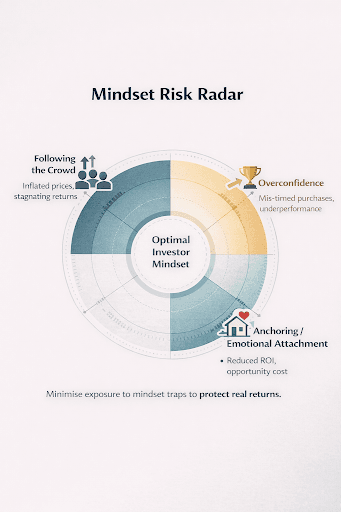
Psychological risks increase gradually and often go unnoticed. Exposure to behavioral traps can quietly raise downside risk and reduce real-world returns, even when headline metrics appear strong. Managing mindset risk is as critical as evaluating rental yield, IRR, or exit assumptions when protecting long-term capital.
Summary Table: Psychological Traps and Smart Investor Responses
| Trap | Common Behavior | Risk | Smart Investor Response |
|---|---|---|---|
| Following the crowd | Buying because everyone else is | Inflated prices, stagnant returns | Focus on rental yield, occupancy, and demand |
| Overconfidence | Relying on intuition or ego | Mis-timed purchases, underperformance | Let metrics guide decisions |
| Anchoring and emotion | Overpaying for preferred assets | Reduced ROI, opportunity cost | Compare comps and prioritise returns |
Why Mindset Matters More Than Numbers
Even with rigorous financial analysis, psychological bias can erode outcomes. Recognising these traps gives investors a structural advantage:
Avoid chasing momentum Make objective, data-led decisions Reduce overexposure to market cycles Protect long-term wealth creation
For HNI and UHNI investors, managing behavioral risk is as important as evaluating yields, IRR, or payback periods.
Protect Returns by Protecting Your Mindset
The most successful real estate investors are not those who chase the hottest markets. They are those who stay disciplined, resist psychological traps, and allow data to guide decisions.
By recognising crowd mentality, overconfidence, and emotional attachment, investors can make more resilient choices and protect long-term returns.
In real estate, mindset is capital. Train it carefully, and it will safeguard your wealth. Intitutional real estate offerings.